Earlier this week I finished On, Off by Colleen McCullough. It was one of those books about which I felt ambivalent in the early chapters, but to which I warmed considerably once the proverbial ball was rolling. Unbeknown to me until after I finished reading, McCullough drew upon her own experience in the fields of medicine and medical research to some extent in crafting this novel about a series of murders linked to a neuroscience facility in Connecticut.
While reading I had some reservations about some things -- McCullough's use of inventory-styled description; timelines, interviews, and interrogations which sometimes called into question the thoroughness of the police department; and the apparent willingness of the protagonist to make assumptions about suspects -- I still found myself interested in the story and, about halfway through the book, felt my reading build momentum and motivation.
While the characters aren't as well developed, on the whole, as those in recent crime thriller reads from Stieg Larsson and Jo Nesbø, (perhaps surprising, since McCullough also wrote the character-driven Thorn Birds), they worked and sat suitably in the story. There are shudderingly horrific revelations about the crimes, but they are handled with tact; there are sufficient clues to allow the reader to play along with the police (I managed to identify the guilty, though I was a bit frustrated that the Lieutenant took longer to grow suspicious than I, a lowly couch-detective). In the end, my verdict is that it's a solid, if not spectacular, crime novel.
When I first heard of Pride and Prejudice and Zombies, I was mildly amused and thought little more of it. When it became a best-seller, I became more interested. I'd read Jane Austen's novel many years ago and wondered how the added element of zombies might play out, particularly when set in the language of Austen's work among the plot which centres on nineteenth century manners, attractions, morality, and marriage.
And it was surprisingly entertaining, with the Bennet sisters well-versed in the "deadly arts" and acting as protectors of their beloved Hertfordshire community against the hoards of the living dead, or "unmentionables", even as they go about the business of calling upon neighbours and seeking out husbands.
That is to say it was surprisingly entertaining for a time.
The opening paragraph of Seth Grahame-Smith's ... let's call it an adaptation ... is quite a delightful spoof of Austin's opening.
Austen's: "It is a truth universally acknowledged, that a single man in possession of a good fortune must be in want of a wife."
Grahame-Smith's: "It is a truth universally acknowledged that a zombie in possession of brains must be in want of more brains. Never was this more plain than during the recent attacks at Netherfield Park, in which a household of eighteen was slaughtered and consumed by a horde of the living dead."
The problem is that once going, Grahame-Smith isn't quite sure to do with the zombies. There are a few wonderful scenes that marry this concept with the material -- a dinner party interrupted by a necessary slaughter of the undead, though a few among the living meet a bloody end along the way -- but after a point, Grahame-Smith just doesn't know what to do with the idea that he has committed to (or, more accurately, been committed to, as he was approached by the publishers to create the adaptation in the first place). The story is more about exploiting the idea that the Bennet sisters (and Elizabeth, in particular), are masterful killing machines than about the zombie threat. Indeed, there is a shark, and it is jumped surprisingly early in the book (on page 132, to be precise).
What started as an amusing spoof and homage to the styles of language and manners in Austen's work simply becomes arduous. By the final third of the book, I was wishing I was just reading the original again, as it would have been more purposeful and focused. I have no need of reading the prequel nor the sequel which have since been created by other authors sucked in by the publisher.
Finally, and most upliftingly, I read Wonderstruck, the latest marriage of text and images by Brian Selznick, author of The Invention of Hugo Cabret.
Ben, in 1977, is mourning the death of his mother and, following an accident that leaves him deaf, becomes obsessed with finding the father about which he has known nothing. Rose, in 1927, is fascinated by a silent film star about whom she keeps a scrapbook. The two stories, one told in words and one in images, are presented in tandem until, inevitably, they become interlaced.
Selznick's copious illustrations capture a cinematic style, making extensive and thoughtful use of framing and composition, and he's expert at storytelling with simple images. If there is a criticism to be made, it's that he seems to have difficulty capturing movement of his human figures, and perhaps that his characters tend to be too consistently possess wide-eyed expressions, but the truth is that these are minor complaints when set within his visual storytelling. His style is very different from that required by the usual graphic novel, where movement and activity in images take the place of most narrative text and therefore require the energy and punch to sustain the audience from cover-to-cover.
Wonderstruck is a worthy follow-up to Hugo Cabret and, while it may be a story told at a gentler pace, it breaks new ground for Selznick in structure. It's a worthwhile read for a young audience, for certain.
Showing posts with label books and reading. Show all posts
Showing posts with label books and reading. Show all posts
Tuesday, July 24, 2012

Thursday, July 19, 2012
The 2012 Summer Reading Spectacular #8
Jim Henson's Tale of Sand is a graphic novel based on an unproduced screenplay by Jim Henson and Jerry Juhl back in the days before The Muppet Show launched them into international stardom. Long buried and largely forgotten in the Henson 'vaults', it was revived and brought to life in printed form.
Canadian artist Ramon Perez has done a pretty incredible job of bringing a cinematic quality to the visual storytelling (essential, since there's minimal dialogue in the story), and it's a pretty gorgeous example of his work. The story itself is surreal and captivating, and a great example of Henson's interests behind the puppets. Mac, a rugged everyman, races across a desert landscape with little but his wits and a rucksack, pursued by a dapper man in an eye-patch. (I'm still wanting to see his early experimental film works -- the Oscar-nominated Time Piece and the television project The Cube -- and this could have capped off the trilogy nicely, I'm sure. TIFF, I'm waiting on your Henson exhibit!)
Just last week, Tale of Sand won three Eisner awards, making my reading quite timely.
Canadian artist Ramon Perez has done a pretty incredible job of bringing a cinematic quality to the visual storytelling (essential, since there's minimal dialogue in the story), and it's a pretty gorgeous example of his work. The story itself is surreal and captivating, and a great example of Henson's interests behind the puppets. Mac, a rugged everyman, races across a desert landscape with little but his wits and a rucksack, pursued by a dapper man in an eye-patch. (I'm still wanting to see his early experimental film works -- the Oscar-nominated Time Piece and the television project The Cube -- and this could have capped off the trilogy nicely, I'm sure. TIFF, I'm waiting on your Henson exhibit!)
Just last week, Tale of Sand won three Eisner awards, making my reading quite timely.
Thursday, July 12, 2012
The 2012 Summer Reading Spectacular #6
The Flint Heart is described as "freely abridged from the 1910 story by Eden Phillpotts" by Katherine and John Paterson. I haven't been quite able to discover exactly how much abridgement and how much rewriting has been involved, and I haven't read the original story, either (though I guess that technically I could -- it is still out there), but regardless, the authors have impressively retained the flavour of children's stories from the opening of the 20th century.
In short, the novel deals with the creation and influence of a flint heart, which hardens the heart of its owner and causes them to become callous and greedy. Fairies, animals, kind-hearted children, and a hot water bottle made in Germany all figure into the adventure.
It's interesting that what I like most about the book may also limit its audience. This reworking, though published in 2011, has retained the feel and voice of children's stories a century ago (and according to reviews, it's retained much of the original text, as well). I'm not sure how the average young reader (or parent of the average young reader) today will handle the vocabulary and rather elegant turns of phrase that are largely responsible for the book's charm.
Adults may find the episodic nature of the book tiresome, but I suspect that kids will be more accepting of it. Word is it's being adapted into a film, so I'm interested in whether that adaptation will retain the tone of the storytelling. I'm not sure how much a more contemporary style would help (sales) or hinder (the heart) of the story.
In short, the novel deals with the creation and influence of a flint heart, which hardens the heart of its owner and causes them to become callous and greedy. Fairies, animals, kind-hearted children, and a hot water bottle made in Germany all figure into the adventure.
It's interesting that what I like most about the book may also limit its audience. This reworking, though published in 2011, has retained the feel and voice of children's stories a century ago (and according to reviews, it's retained much of the original text, as well). I'm not sure how the average young reader (or parent of the average young reader) today will handle the vocabulary and rather elegant turns of phrase that are largely responsible for the book's charm.
Adults may find the episodic nature of the book tiresome, but I suspect that kids will be more accepting of it. Word is it's being adapted into a film, so I'm interested in whether that adaptation will retain the tone of the storytelling. I'm not sure how much a more contemporary style would help (sales) or hinder (the heart) of the story.
Wednesday, July 11, 2012
The 2012 Summer Reading Spectacular #5
I was feeling like I'm not getting as much reading done as usual, but as I typed the '#5' above, I realized I must be doing alright despite not having a hermitage to which I can escape.
Clive Barker's The Thief of Always is part Coraline and part Flight of the Navigator (though it predates the former and follows the latter), another variation on "be careful what you wish for" narratives that's done well. In short, Harvey Swick, bored with life, is lured to a mysterious and magical house that offers to supply his every wish and whim, but he soon discovers the darker side of those delights.
It's a short, well-plotted, and quickly moving novel with just enough darkness and grotesquery to give kids the willies but not nightmares. If there's a complaint, it's in the fact that a major turning point in the protagonist's journey seems to be based on an assumption that's a bit of a leap. Not a big criticism, and unlikely to be one noted by the young intended audience. In the novel, one can almost see the seeds of Barker's Abarat series as he experiments with how creepy he can go with the imagery in young people's literature.
Clive Barker's The Thief of Always is part Coraline and part Flight of the Navigator (though it predates the former and follows the latter), another variation on "be careful what you wish for" narratives that's done well. In short, Harvey Swick, bored with life, is lured to a mysterious and magical house that offers to supply his every wish and whim, but he soon discovers the darker side of those delights.
It's a short, well-plotted, and quickly moving novel with just enough darkness and grotesquery to give kids the willies but not nightmares. If there's a complaint, it's in the fact that a major turning point in the protagonist's journey seems to be based on an assumption that's a bit of a leap. Not a big criticism, and unlikely to be one noted by the young intended audience. In the novel, one can almost see the seeds of Barker's Abarat series as he experiments with how creepy he can go with the imagery in young people's literature.
Saturday, July 07, 2012
The 2012 Summer Reading Spectacular #3
Sometimes a book sits on the shelf for years waiting patiently to be read. Beyond the Chocolate War was one such book.
The reason for the delay was simple, though unnecessary. I didn't want to read it until I'd read The Chocolate War, and I didn't have that one sitting on my shelf. The wait was ridiculous, of course, since of all Robert Cormier's books, The Chocolate War is one of his best known and has always been available. But there it is. I just hadn't gotten around to getting it. Then I did, then I read it, then I could read Beyond the Chocolate War. Simple.
Although the books together span a single year at Trinity High School, they were published over a decade apart. If the first is an exploration of how conformity breeds corruption and the dangers of nonconformity (and it's an oversimplification to say it is), then the second could be seen as an exploration of the ways in which that conformity and corruption is perpetuated when individuals feel isolated and alone -- just like everyone else.
The problem here is that I don't really want to talk too much about the book's plot or characters, as to do so would necessarily constitute spoilers for the first of the two books. Needless to say the books aren't simple or chock-full-of-sunshine -- The Chocolate War is one of the most challenged and banned young people's novels though measured against the movies teenagers watch, it's hard to understand why -- but they're worthwhile reads. Though the situations themselves may seem extreme at first, there is also something uncomfortably familiar about them, too.
And you read an article about a senior citizen being cruelly harassed by grade seven kids on a bus in 2012 ...
"You could have said no anytime, anytime at all. But you didn't ..."
The reason for the delay was simple, though unnecessary. I didn't want to read it until I'd read The Chocolate War, and I didn't have that one sitting on my shelf. The wait was ridiculous, of course, since of all Robert Cormier's books, The Chocolate War is one of his best known and has always been available. But there it is. I just hadn't gotten around to getting it. Then I did, then I read it, then I could read Beyond the Chocolate War. Simple.
Although the books together span a single year at Trinity High School, they were published over a decade apart. If the first is an exploration of how conformity breeds corruption and the dangers of nonconformity (and it's an oversimplification to say it is), then the second could be seen as an exploration of the ways in which that conformity and corruption is perpetuated when individuals feel isolated and alone -- just like everyone else.
The problem here is that I don't really want to talk too much about the book's plot or characters, as to do so would necessarily constitute spoilers for the first of the two books. Needless to say the books aren't simple or chock-full-of-sunshine -- The Chocolate War is one of the most challenged and banned young people's novels though measured against the movies teenagers watch, it's hard to understand why -- but they're worthwhile reads. Though the situations themselves may seem extreme at first, there is also something uncomfortably familiar about them, too.
And you read an article about a senior citizen being cruelly harassed by grade seven kids on a bus in 2012 ...
"You could have said no anytime, anytime at all. But you didn't ..."
Monday, July 02, 2012
The 2012 Summer Reading Spectacular #2
With a lot of new reading on the go, I only finished one book today.
Darryl Cunningham's Psychiatric Tales: Eleven Graphic Stories about Mental Illness is a series of short anecdotal chapters based on the author's experiences working in the mental health field. Part case study, part information, the book aims to break down the stigma associated with mental illness. Its matter-of-fact tone is reminiscent of Marjane Satrapi's works (the author, in his introduction, credits Persepolis with inspiring him to use the graphic form to say what he wanted to say), as does its autobiographical content. Though not the storyteller that Satrapi is, the understated tone and structure of the book somehow work reasonably well. The chapters do not necessarily strive for a complete narrative arc, but rather act to highlight a particular truth in a nugget-like form.
Darryl Cunningham's Psychiatric Tales: Eleven Graphic Stories about Mental Illness is a series of short anecdotal chapters based on the author's experiences working in the mental health field. Part case study, part information, the book aims to break down the stigma associated with mental illness. Its matter-of-fact tone is reminiscent of Marjane Satrapi's works (the author, in his introduction, credits Persepolis with inspiring him to use the graphic form to say what he wanted to say), as does its autobiographical content. Though not the storyteller that Satrapi is, the understated tone and structure of the book somehow work reasonably well. The chapters do not necessarily strive for a complete narrative arc, but rather act to highlight a particular truth in a nugget-like form.
Sunday, July 01, 2012
The 2012 Summer Reading Spectacular #1
That's right! I'm back for another summer of reading commentary. Why, you ask? Because it's all so fascinating and thousands (or one or two) are awaiting it eagerly.
It will appear that today was an incredibly productive reading day as I have three books to mention, but really I just had a few on the go and it so happens that I was nearing the end of three when I awoke this fine morning.
First up, I finished Nemesis by Jo Nesbø. This is the fourth in the Norwegian series about alcoholic police detective Harry Hole but, curiously, the second translated into English. (Characters often make references to events in the first two volumes which have yet to be available in English, but it doesn't get in the way of the stories, so I suppose it'll have to be alright.) It's quite an intricately assembled cop thriller, with quite a lot of interlacing story lines -- a series of bank robberies, a suspicious suicide, a cop being set-up while another his predatory nature -- but it is a lot more readable than it may sound. Both Harry Hole books I've read so far are pretty brisk, motivated reads that I've quite enjoyed. Bring on The Devil's Star! (It's already ordered.)
Next I wrapped up Mr. Stink the second children's novel from David Walliams, best known as half of the comedy duo (with Matt Lucas) responsible for Little Britain. An unpopular but kindly-hearted girl, Chloe, takes an interest in the local tramp, Mr. Stink, and the two forge a friendly, though smelly, relationship. Toss in an overachieving little sister, a snobbish and politically motivated mother, and a father with failed rock-star dreams and you've got a silly little book that's a decent diversion, if not exactly a literary masterpiece. There are a few toss-away moments that don't really need to be there for the story, and a few distinctly British naughty-isms (but innocent enough, really), but the some of the parts are likely to amuse young readers.
Finally, I read We Have Always Lived in the Castle, the final novel of Shirley Jackson (of The Lottery fame). This book was on a recommended reading list I'd come across a few months back. It's a gothic story about a pair of recluse sisters who live with their uncle, locked away in a once-grand estate, hiding away from the villagers and their sing-song taunts and rumours arsenic incident that resulted in the deaths of the rest of the family. The climactic scene is both surreal and disturbingly familiar; the final impression left, a curious blend of despair and hope. Not everyone's cup of tea, but I quite liked the dark, quirky tone of the book (thanks to the somewhat sociopathic nature of the narrator, younger sister Merricat) and the heightened, but still sympathetic, characters.
All-in-all, it was a good start to the summer's reading!
First up, I finished Nemesis by Jo Nesbø. This is the fourth in the Norwegian series about alcoholic police detective Harry Hole but, curiously, the second translated into English. (Characters often make references to events in the first two volumes which have yet to be available in English, but it doesn't get in the way of the stories, so I suppose it'll have to be alright.) It's quite an intricately assembled cop thriller, with quite a lot of interlacing story lines -- a series of bank robberies, a suspicious suicide, a cop being set-up while another his predatory nature -- but it is a lot more readable than it may sound. Both Harry Hole books I've read so far are pretty brisk, motivated reads that I've quite enjoyed. Bring on The Devil's Star! (It's already ordered.)
Next I wrapped up Mr. Stink the second children's novel from David Walliams, best known as half of the comedy duo (with Matt Lucas) responsible for Little Britain. An unpopular but kindly-hearted girl, Chloe, takes an interest in the local tramp, Mr. Stink, and the two forge a friendly, though smelly, relationship. Toss in an overachieving little sister, a snobbish and politically motivated mother, and a father with failed rock-star dreams and you've got a silly little book that's a decent diversion, if not exactly a literary masterpiece. There are a few toss-away moments that don't really need to be there for the story, and a few distinctly British naughty-isms (but innocent enough, really), but the some of the parts are likely to amuse young readers.
Finally, I read We Have Always Lived in the Castle, the final novel of Shirley Jackson (of The Lottery fame). This book was on a recommended reading list I'd come across a few months back. It's a gothic story about a pair of recluse sisters who live with their uncle, locked away in a once-grand estate, hiding away from the villagers and their sing-song taunts and rumours arsenic incident that resulted in the deaths of the rest of the family. The climactic scene is both surreal and disturbingly familiar; the final impression left, a curious blend of despair and hope. Not everyone's cup of tea, but I quite liked the dark, quirky tone of the book (thanks to the somewhat sociopathic nature of the narrator, younger sister Merricat) and the heightened, but still sympathetic, characters.
All-in-all, it was a good start to the summer's reading!
Monday, September 05, 2011
The Summer 2011 Reading Spectacular #10: The Finale
I doubt I'm going to finish any of the books I'm reading before the end of the day (including, The Fall by Guillermo del Toro and Chuck Hogan, Death of an Ordinary Man by Glen Duncan, The Thief of Always by Clive Barker, The Black Hole War: My Battle with Stephen Hawking to Make the World Safe for Quantum Mechanics by Leonard Susskind, and The Gift of Thanks by Margaret Visser, among other things), so here's the official photo of my summer reading!

Now comes the challenging task of figuring out where to put this collection on my numerous -- but generally jam-packed -- bookshelves.
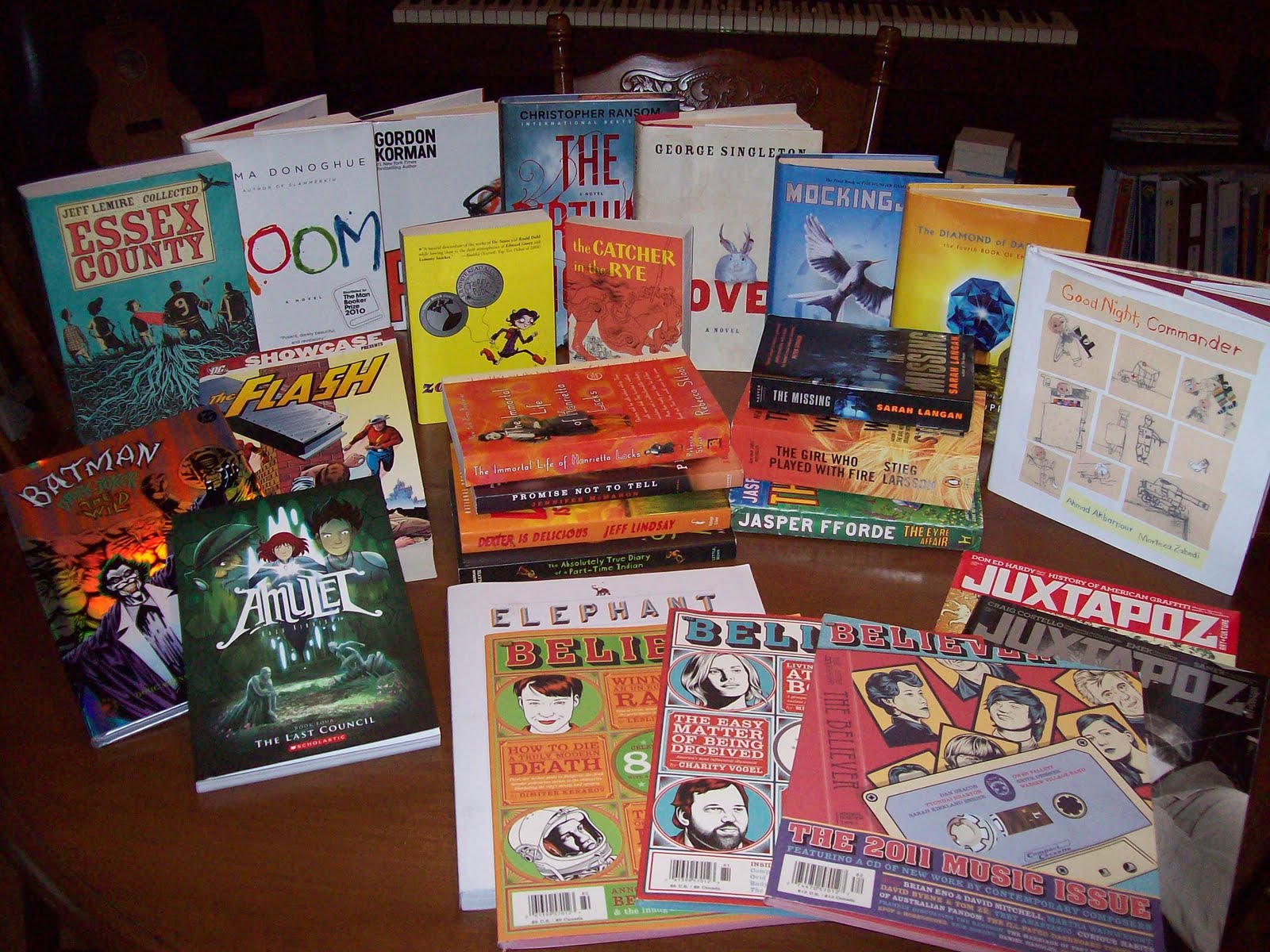
Now comes the challenging task of figuring out where to put this collection on my numerous -- but generally jam-packed -- bookshelves.
The Summer 2011 Reading Spectacular #9
Two more books to add!
Several years ago I picked up and read Something Rotten by Jasper Fforde. I hadn't realized at the time that it fell several books into a series. I still read it, filling in the essential blanks using clues within the text (how's that for teacher talk?) and enjoyed the book immensely. It seemed appropriate, naturally, to go back and start at the beginning, and that's what I did this summer, reading The Eyre Affair, book one in the Thursday Next series.
Oh, how to describe this book? Imagine a world (a 1985, specifically), in which Dodos have returned as housepets thanks to cloning, in which the English and Russians are at war over the Crimea, The Goliath Corporation holds suspicious power over politics, and disturbances in the time-space continuum sometimes occur along the highway. Even better, works of art and literature are like pop-stars, with rabid fans but also inspiring criminal masterminds to attack them. Oh, that's just the tip of the iceberg. So much absurd fun!
I also read Amulet: Book Four - The Last Council by Kazu Kibuishi. I reported briefly on the first book in the series as part of my first ever Summer Reading Spectacular entry. A kid-friendly fantasy series, I'm still enjoying the series, though the sparse dialogue makes for a very quick read, leaving me feeling, at times, that I'd like the story to make more progress in a given volume. The artwork is quite nice, with backgrounds particularly impressive in their detail and beauty contrasted with very simple, flat character designs. Characters can also look a lot alike -- the facial design is very simple and used often -- so pay attention to hair and clothing to help keep everyone straight. I'm not sure how long this series is expected to last, but word has it a movie is in the works.
Several years ago I picked up and read Something Rotten by Jasper Fforde. I hadn't realized at the time that it fell several books into a series. I still read it, filling in the essential blanks using clues within the text (how's that for teacher talk?) and enjoyed the book immensely. It seemed appropriate, naturally, to go back and start at the beginning, and that's what I did this summer, reading The Eyre Affair, book one in the Thursday Next series.
Oh, how to describe this book? Imagine a world (a 1985, specifically), in which Dodos have returned as housepets thanks to cloning, in which the English and Russians are at war over the Crimea, The Goliath Corporation holds suspicious power over politics, and disturbances in the time-space continuum sometimes occur along the highway. Even better, works of art and literature are like pop-stars, with rabid fans but also inspiring criminal masterminds to attack them. Oh, that's just the tip of the iceberg. So much absurd fun!
I also read Amulet: Book Four - The Last Council by Kazu Kibuishi. I reported briefly on the first book in the series as part of my first ever Summer Reading Spectacular entry. A kid-friendly fantasy series, I'm still enjoying the series, though the sparse dialogue makes for a very quick read, leaving me feeling, at times, that I'd like the story to make more progress in a given volume. The artwork is quite nice, with backgrounds particularly impressive in their detail and beauty contrasted with very simple, flat character designs. Characters can also look a lot alike -- the facial design is very simple and used often -- so pay attention to hair and clothing to help keep everyone straight. I'm not sure how long this series is expected to last, but word has it a movie is in the works.
Sunday, September 04, 2011
The Summer 2011 Reading Spectacular #8
Not far from the finish line for another summer...
First up in this entry, Mockingjay by Suzanne Collins. The final entry in the Hunger Games trilogy, it was a satisfying conclusion to the series, though I can't deny that the love triangle thread (between Katniss, Peeta, and Gale) has become a bit tiresome by the time we reach the halfway point in this, the third book in which it figures. I was unbothered by the unresolved pieces of the puzzle (I'm not a fan of everything being too tidily resolved, at the best of times). All told, it's a young adult series worth reading, and adults will find it an enjoyable light read, too. I'm hoping the film adaptation doesn't mess it up. Previews look good, at least.
Another issue of The Believer (No. 82 -- The Music Issue) was completed early in August. Who knew that they tried putting turntables in car dashboards in the 60s (other than those who were looking to buy luxury cars in the 60s)? Where else would an article about the bassoon (and its reputation as the orchestral comedian) be entitled 'The Farting Bedpost'? Did you know that KPOP (Korean Pop Music) had a rabid fanbase that would make Beatlemaniacs blush? Good times (with bad comics, again).
Showcase presents The Flash, after a shelf-sitting hiatus, came back into the reading circulation and was finished at last. A collection of black-and-white reprints from the 60s (over 500 pages' worth!), it is highly amusing to see how the tone of comics has changed since the Silver Age. Apart from a general sense of camp in the storytelling, it's also entertaining to see how the prevalence of "radiations" of all sorts reflects the times.
Keeping in the comics genre, I re-read the graphic novel Batman: Dark Joker - The Wild, an Elseworlds story from 1993. I'd pretty much forgotten the whole thing until I unearthed it while sorting things from the basement in the Spring. While the concept is intriguing (in a Medievalesque fantasy land, Dark Joker is a powerful and evil wizard; the Batman is the disfigured hero who will bring about his fall), the storytelling itself isn't quite as strong as I would like. The artwork, on the whole, is quite nice, though, with a little gore to spare.
First up in this entry, Mockingjay by Suzanne Collins. The final entry in the Hunger Games trilogy, it was a satisfying conclusion to the series, though I can't deny that the love triangle thread (between Katniss, Peeta, and Gale) has become a bit tiresome by the time we reach the halfway point in this, the third book in which it figures. I was unbothered by the unresolved pieces of the puzzle (I'm not a fan of everything being too tidily resolved, at the best of times). All told, it's a young adult series worth reading, and adults will find it an enjoyable light read, too. I'm hoping the film adaptation doesn't mess it up. Previews look good, at least.
Another issue of The Believer (No. 82 -- The Music Issue) was completed early in August. Who knew that they tried putting turntables in car dashboards in the 60s (other than those who were looking to buy luxury cars in the 60s)? Where else would an article about the bassoon (and its reputation as the orchestral comedian) be entitled 'The Farting Bedpost'? Did you know that KPOP (Korean Pop Music) had a rabid fanbase that would make Beatlemaniacs blush? Good times (with bad comics, again).
Showcase presents The Flash, after a shelf-sitting hiatus, came back into the reading circulation and was finished at last. A collection of black-and-white reprints from the 60s (over 500 pages' worth!), it is highly amusing to see how the tone of comics has changed since the Silver Age. Apart from a general sense of camp in the storytelling, it's also entertaining to see how the prevalence of "radiations" of all sorts reflects the times.
Keeping in the comics genre, I re-read the graphic novel Batman: Dark Joker - The Wild, an Elseworlds story from 1993. I'd pretty much forgotten the whole thing until I unearthed it while sorting things from the basement in the Spring. While the concept is intriguing (in a Medievalesque fantasy land, Dark Joker is a powerful and evil wizard; the Batman is the disfigured hero who will bring about his fall), the storytelling itself isn't quite as strong as I would like. The artwork, on the whole, is quite nice, though, with a little gore to spare.
Saturday, September 03, 2011
The Summer 2011 Reading Spectacular #7
Well, I thought I was getting close to caught up, but here I am, having fallen behind yet again. I've got three days to finish up, because it's almost Labour Day! Yikes!
Juxtapoz: Issue 127 was more of what I enjoy from the magazine, art and artists with whom I'm generally unfamiliar. Though I think the magazine may focus too frequently in graffiti artists from month to month, I particularly enjoyed the articles about Emek, a poster designer/graphic artist, and Mary Iverson, who draws shipping containers on landscape photos, and the interview with Gus van Sant.
Among my lighter reads this summer was Pop by Gordon Korman. Korman has been trying to branch out a bit in recent years, experimenting more frequently with adventure serials (Island, Everest, etc.) and with more "young adult" novels (Son of the Mob, Born to Rock), and Pop falls into this latter category. While it's not as whimsical as Korman's earlier teen novels (Don't Care High, A Semester in the Life of a Garbage Bag, in particular), it was still a decent, light read.
Marcus moves to a new town with his mother and finds himself dealing with the politics of the local High School Football team. He is buoyed, if stymied, by the unexpected friendship of an eccentric, middle aged man he meets in the park and who ends up participating in Marcus's informal training. When the nature of his new friend begins to come to light, Marcus finds his life more complicated than he'd first realized.
Back to a magazine (my favourite magazine, incidentally), Issue 81 of The Believer was another eclectic and enjoyable read. Highlights of this issue included "The Forefather of Charm", an article about the Genuine Fakir of Ava, a magician with a knack for enticing audiences with the promise of prizes (and to whom shows like The Price Is Right owe a debt of gratitude, I'm sure), and an interview with photographer Lena Herzog. A low point, as always, were the stupid comics, which are not generally insightful, witty, or funny. The magazine is so wonderful that the comics always make me a little sad.
Later in the summer, I read yet another issue of The Believer, which I'll get to mentioning before Monday leaves us.
Dexter is Delicious, fourth in the Dexter series by Jeff Lindsay, was next on the completion list. An enormous step up from the third in the series, which went off the rails, in my opinion, it seemed that Dexter was getting back on track story-wise. Though I still think the character seems to be pretty consistently sloppy for someone who has been established as obsessively careful and systematic, I generally liked where things went. Though I'm not sure that I'll be able to "buy" where things are headed with elements of Dexter's happy home life, I'll still be picking up the next book when it's out in paperback.
Juxtapoz: Issue 127 was more of what I enjoy from the magazine, art and artists with whom I'm generally unfamiliar. Though I think the magazine may focus too frequently in graffiti artists from month to month, I particularly enjoyed the articles about Emek, a poster designer/graphic artist, and Mary Iverson, who draws shipping containers on landscape photos, and the interview with Gus van Sant.
Among my lighter reads this summer was Pop by Gordon Korman. Korman has been trying to branch out a bit in recent years, experimenting more frequently with adventure serials (Island, Everest, etc.) and with more "young adult" novels (Son of the Mob, Born to Rock), and Pop falls into this latter category. While it's not as whimsical as Korman's earlier teen novels (Don't Care High, A Semester in the Life of a Garbage Bag, in particular), it was still a decent, light read.
Marcus moves to a new town with his mother and finds himself dealing with the politics of the local High School Football team. He is buoyed, if stymied, by the unexpected friendship of an eccentric, middle aged man he meets in the park and who ends up participating in Marcus's informal training. When the nature of his new friend begins to come to light, Marcus finds his life more complicated than he'd first realized.
Back to a magazine (my favourite magazine, incidentally), Issue 81 of The Believer was another eclectic and enjoyable read. Highlights of this issue included "The Forefather of Charm", an article about the Genuine Fakir of Ava, a magician with a knack for enticing audiences with the promise of prizes (and to whom shows like The Price Is Right owe a debt of gratitude, I'm sure), and an interview with photographer Lena Herzog. A low point, as always, were the stupid comics, which are not generally insightful, witty, or funny. The magazine is so wonderful that the comics always make me a little sad.
Later in the summer, I read yet another issue of The Believer, which I'll get to mentioning before Monday leaves us.
Dexter is Delicious, fourth in the Dexter series by Jeff Lindsay, was next on the completion list. An enormous step up from the third in the series, which went off the rails, in my opinion, it seemed that Dexter was getting back on track story-wise. Though I still think the character seems to be pretty consistently sloppy for someone who has been established as obsessively careful and systematic, I generally liked where things went. Though I'm not sure that I'll be able to "buy" where things are headed with elements of Dexter's happy home life, I'll still be picking up the next book when it's out in paperback.
Sunday, August 07, 2011
The Summer 2011 Reading Spectacular #6
Almost there.
Remember when I was writing about Novel and I mentioned how sometimes a book doesn't live up to what it should have been? If you don't remember, you can check it out here. Well, I've another to add to that list: Zorgamazoo by Canadian writer Robert Paul Weston. Where to begin? Okay, how about with the basics of the book? It's a light little fantasy romp about a girl (being pursued by nasties who want to give her a lobotomy) who winds up having an adventure involving mythic and fanciful creatures including the Zorgles from -- where else? -- Zorgamazoo. It's written in rhyming verse. That's important.
So what's the problem, you ask. What's not to like about rhyming verse, you ask. Don't you like Dr. Seuss, you ask. Don't you enjoy adventures, you ask. Do you not thrill at the magical worlds of fanciful creatures, you ask. Well, I answer, stop asking so many questions so I can explain.
First off, the verse. I indeed DO love Dr. Seuss! The verse here, however, becomes so tedious, as it goes on page after page after page after page! And even worse, I often felt like I was reading an early draft of Weston's work. If I could stomach re-reading the book, I'd take a count of how many times he filled in syllables with one of his pet phrases: "you see" and "in fact", as I recall, appeared with alarming frequency. Ug.
I'll barely say anything about the title, apart from mentioning that almost none of the story takes place in Zorgamazoo, and to clarify that it's of minimal importance to the plot at all.
Finally, the story is just underdeveloped. So much time has been spent on trying to force the rhyme and rhythm that Weston seems to have neglected to notice that he doesn't have the character or plot development to justify a novel at all. The whole thing would have been better served as a picture book. The book is divided into rather short chapters, and I'm not being facetious when I say I seldom read more than one chapter in a sitting.
In fairness, I should point out that the book has been given several honours, including the E.B. White Read Aloud Award and the Silver Birch Award (which is selected by children). I can only assume that the givers of this award were distracted by the rhyming verse and ended up giving an award for the book's writing structure rather than for its actual literary merit and content. I'm sure kids will enjoy it, but I'm finished with it.
On a better note, July also found me reading The Absolutely True Diary of a Part-Time Indian by Sherman Alexie. I'm not entirely sure why the title claims the content will be a diary, because it doesn't particularly read that way, but I suppose it's due to the inclusion of cartoons and drawings "by the narrator". In any case, I had a much more positive response to this book than to a certain other recent read (whose title rhymes with "Borgamazoo").
The book is written in the voice of Junior (Arnold Spirit, Jr.), a Native American teenager who makes the difficult and unpopular choice to attend an all-white school off the reserve. The book deals quite frankly with several issues including poverty, abuse of various types, and racism and, as a result, has been the focus of both praise and controversy. It's apparently been banned in a few US school boards. Alexie has mixed a fair bit of autobiographical material into his novel and, perhaps in view of this, it becomes difficult to see the inclusion of some coarse language, mature themes, and sexual references as simply being salacious.
The Absolutely True Diary of a Part-Time Indian was awarded the National Book Award.
Remember when I was writing about Novel and I mentioned how sometimes a book doesn't live up to what it should have been? If you don't remember, you can check it out here. Well, I've another to add to that list: Zorgamazoo by Canadian writer Robert Paul Weston. Where to begin? Okay, how about with the basics of the book? It's a light little fantasy romp about a girl (being pursued by nasties who want to give her a lobotomy) who winds up having an adventure involving mythic and fanciful creatures including the Zorgles from -- where else? -- Zorgamazoo. It's written in rhyming verse. That's important.
So what's the problem, you ask. What's not to like about rhyming verse, you ask. Don't you like Dr. Seuss, you ask. Don't you enjoy adventures, you ask. Do you not thrill at the magical worlds of fanciful creatures, you ask. Well, I answer, stop asking so many questions so I can explain.
First off, the verse. I indeed DO love Dr. Seuss! The verse here, however, becomes so tedious, as it goes on page after page after page after page! And even worse, I often felt like I was reading an early draft of Weston's work. If I could stomach re-reading the book, I'd take a count of how many times he filled in syllables with one of his pet phrases: "you see" and "in fact", as I recall, appeared with alarming frequency. Ug.
I'll barely say anything about the title, apart from mentioning that almost none of the story takes place in Zorgamazoo, and to clarify that it's of minimal importance to the plot at all.
Finally, the story is just underdeveloped. So much time has been spent on trying to force the rhyme and rhythm that Weston seems to have neglected to notice that he doesn't have the character or plot development to justify a novel at all. The whole thing would have been better served as a picture book. The book is divided into rather short chapters, and I'm not being facetious when I say I seldom read more than one chapter in a sitting.
In fairness, I should point out that the book has been given several honours, including the E.B. White Read Aloud Award and the Silver Birch Award (which is selected by children). I can only assume that the givers of this award were distracted by the rhyming verse and ended up giving an award for the book's writing structure rather than for its actual literary merit and content. I'm sure kids will enjoy it, but I'm finished with it.
On a better note, July also found me reading The Absolutely True Diary of a Part-Time Indian by Sherman Alexie. I'm not entirely sure why the title claims the content will be a diary, because it doesn't particularly read that way, but I suppose it's due to the inclusion of cartoons and drawings "by the narrator". In any case, I had a much more positive response to this book than to a certain other recent read (whose title rhymes with "Borgamazoo").
The book is written in the voice of Junior (Arnold Spirit, Jr.), a Native American teenager who makes the difficult and unpopular choice to attend an all-white school off the reserve. The book deals quite frankly with several issues including poverty, abuse of various types, and racism and, as a result, has been the focus of both praise and controversy. It's apparently been banned in a few US school boards. Alexie has mixed a fair bit of autobiographical material into his novel and, perhaps in view of this, it becomes difficult to see the inclusion of some coarse language, mature themes, and sexual references as simply being salacious.
The Absolutely True Diary of a Part-Time Indian was awarded the National Book Award.
Saturday, August 06, 2011
The Summer 2011 Reading Spectacular #5
Getting there.
I read the second book in Stieg Larsson’s Millenium Trilogy in July, as well. The Girl Who Played With Fire took a little bit to get the momentum rolling, but once going, it was another quick and easily-motivated read. I normally spread out the reading of books by the same author (particularly those in a series), but I picked up all three of these movies (the Swedish films, obviously, as the North American versions haven’t yet come out) and won’t watch each until I’ve read its book. There are odd little things about the series (I don’t understand why so many characters need to have such colourful sex lives, for one thing, as they're minimally relevant to the plot), but the stories themselves are fun, well-crafted and full of enough interesting turns of plot to keep me reading. It’s not particularly high-brow literature, but hey, who says it has to be? Now I have to wait forever for The Girl Who Kicked the Hornet’s Nest to come out in a paperback edition that matches the two I’ve already got. [Insert dramatic sigh here]
Speaking of not high-brow literature …
Onto some relatively trashy reading, I whipped through The Missing by Sarah Langan, an author I’ve come to enjoy in the past year or so. I don’t normally profess to be a rabid fan of the horror genre (in books or in movies), but I enjoy a good creepy-weird read now and then (and Betsy and I do enjoy watching awful “scary” movies together and laughing). The Missing blends elements of zombie, killer-viruses, and cannibalism together into a decent tale, complete with graphically unpleasant images to spare. Not entirely unlike The Strain by Guillermo del Toro and Chuck Hogan, but preceding it by two years, it moves along between story threads that necessarily become linked, and dives headlong into gore, moving quickly and inexorably toward unpleasantness at nearly every turn. I unwittingly bought this book twice, once under its UK title, Virus, and also under its less-sensical title, The Missing. It was this edition that I read, because it was smaller for carrying around.
Towards the end of July, I also read Promise Not to Tell. I discovered Jennifer McMahon in the same way I discovered Sarah Langan – at a big sale at The Book Depot. (Book Depot, have I told you lately that I love you?) I read another of McMahon’s novels, Dismantled, a year or two ago and enjoyed it immensely. Unlike many suspense/mystery/thriller/whatever this genre really should be called, in which you essentially know the outcome but you’re just seeing how we get there, I found myself having to continually modify my expectations as I moved through Dismantled’s pages.
In some ways, Promise Not to Tell is more straightforward than Dismantled (perhaps this was due to its being a debut novel), but McMahon makes the reader walk the line between supernatural and earthly explanations for what’s happening quite nicely even as she jumps between the story’s present day (2002) and the past (1971), in search of the connection between a recent killing and the unsolved murder of an outcast girl those many years ago.
A curious sidenote is that Promise Not to Tell was released in Germany as Das Mädchen im Wald (The Girl in the Woods). Dismantled was released in the UK under the title Girl in the Woods. How’s that for needless confusion?
I read the second book in Stieg Larsson’s Millenium Trilogy in July, as well. The Girl Who Played With Fire took a little bit to get the momentum rolling, but once going, it was another quick and easily-motivated read. I normally spread out the reading of books by the same author (particularly those in a series), but I picked up all three of these movies (the Swedish films, obviously, as the North American versions haven’t yet come out) and won’t watch each until I’ve read its book. There are odd little things about the series (I don’t understand why so many characters need to have such colourful sex lives, for one thing, as they're minimally relevant to the plot), but the stories themselves are fun, well-crafted and full of enough interesting turns of plot to keep me reading. It’s not particularly high-brow literature, but hey, who says it has to be? Now I have to wait forever for The Girl Who Kicked the Hornet’s Nest to come out in a paperback edition that matches the two I’ve already got. [Insert dramatic sigh here]
Speaking of not high-brow literature …
Onto some relatively trashy reading, I whipped through The Missing by Sarah Langan, an author I’ve come to enjoy in the past year or so. I don’t normally profess to be a rabid fan of the horror genre (in books or in movies), but I enjoy a good creepy-weird read now and then (and Betsy and I do enjoy watching awful “scary” movies together and laughing). The Missing blends elements of zombie, killer-viruses, and cannibalism together into a decent tale, complete with graphically unpleasant images to spare. Not entirely unlike The Strain by Guillermo del Toro and Chuck Hogan, but preceding it by two years, it moves along between story threads that necessarily become linked, and dives headlong into gore, moving quickly and inexorably toward unpleasantness at nearly every turn. I unwittingly bought this book twice, once under its UK title, Virus, and also under its less-sensical title, The Missing. It was this edition that I read, because it was smaller for carrying around.
Towards the end of July, I also read Promise Not to Tell. I discovered Jennifer McMahon in the same way I discovered Sarah Langan – at a big sale at The Book Depot. (Book Depot, have I told you lately that I love you?) I read another of McMahon’s novels, Dismantled, a year or two ago and enjoyed it immensely. Unlike many suspense/mystery/thriller/whatever this genre really should be called, in which you essentially know the outcome but you’re just seeing how we get there, I found myself having to continually modify my expectations as I moved through Dismantled’s pages.
In some ways, Promise Not to Tell is more straightforward than Dismantled (perhaps this was due to its being a debut novel), but McMahon makes the reader walk the line between supernatural and earthly explanations for what’s happening quite nicely even as she jumps between the story’s present day (2002) and the past (1971), in search of the connection between a recent killing and the unsolved murder of an outcast girl those many years ago.
A curious sidenote is that Promise Not to Tell was released in Germany as Das Mädchen im Wald (The Girl in the Woods). Dismantled was released in the UK under the title Girl in the Woods. How’s that for needless confusion?
Friday, August 05, 2011
The Summer 2011 Reading Spectacular #4
Still catching up.
The Immortal Life of Henrietta Lacks, by Rebecca Skloot, is way up on my recommended list. If you were told, “It’s a book about a woman whose cancer cells were harvested in the 50s and ended up being used in innumerable medical studies and breakthroughs since then,” and your response was, “That doesn’t sound so fantastic,” I would understand where you were coming from, but you’d be very, very wrong. This book is pretty amazing.
It’s partly a book about the ethics and principles surrounding cell cultures as commodities. It’s partly the story of an impoverished black woman and her family. It’s entirely readable, entirely fascinating, and entirely a page-turner. I know – who would have thought?
That Rebecca Skloot somehow manages to cover all of this ground and more – the story of her own struggle to convince members of Henrietta Lacks’s family to even talk to her is quite a thread – while time-jumping between the 1950s, the 2000s, and several places in between, is quite remarkable, even more so since she manages to keep the material logical, followable (imagine that is a word), and quickly paced. The little timelines that head each chapter certainly assist in this.
A seriously good read.
I also read The Complete Essex County by Jeff Lemire, which collects three interconnected full-length stories with two mini-comic stories into one graphic novel. All set in a fictionalized version of Essex County, Ontario (the author’s hometown), the book captures grief, secrets, and hope over several generations in the community. Not really for kids, the graphic novel has gained quite a following as a piece of contemporary Canadian literature. The first story in the trilogy, "Tales from the Farm", is apparently in development as a movie (under the unfortunate name “Super Zero”).
The Immortal Life of Henrietta Lacks, by Rebecca Skloot, is way up on my recommended list. If you were told, “It’s a book about a woman whose cancer cells were harvested in the 50s and ended up being used in innumerable medical studies and breakthroughs since then,” and your response was, “That doesn’t sound so fantastic,” I would understand where you were coming from, but you’d be very, very wrong. This book is pretty amazing.
It’s partly a book about the ethics and principles surrounding cell cultures as commodities. It’s partly the story of an impoverished black woman and her family. It’s entirely readable, entirely fascinating, and entirely a page-turner. I know – who would have thought?
That Rebecca Skloot somehow manages to cover all of this ground and more – the story of her own struggle to convince members of Henrietta Lacks’s family to even talk to her is quite a thread – while time-jumping between the 1950s, the 2000s, and several places in between, is quite remarkable, even more so since she manages to keep the material logical, followable (imagine that is a word), and quickly paced. The little timelines that head each chapter certainly assist in this.
A seriously good read.
I also read The Complete Essex County by Jeff Lemire, which collects three interconnected full-length stories with two mini-comic stories into one graphic novel. All set in a fictionalized version of Essex County, Ontario (the author’s hometown), the book captures grief, secrets, and hope over several generations in the community. Not really for kids, the graphic novel has gained quite a following as a piece of contemporary Canadian literature. The first story in the trilogy, "Tales from the Farm", is apparently in development as a movie (under the unfortunate name “Super Zero”).
Wednesday, August 03, 2011
The Summer 2011 Reading Spectacular #3
Yes, I already find myself in the circumstance of playing catch-up. As someone was so kind to point out, I’m on vacation, but I’ve managed to spend most of the past month in places with intermittent internet access and, when at home, I found myself trying to cram in as much as possible.
In any case, here I am, and I plan on bringing everything here up-to-date over the course of the next few days.
Back in July, I managed to get a lot of reading done, mostly thanks for my amazing talent for procrastination. Homework? Peh! I’ve got some serious reading which demands my attention! (Fear not, concerned reader, I did my homework, too.)
I managed to at last read one of those books that it seems everyone read in highschool except for me: J.D. Salinger’s The Catcher in the Rye. It’s funny, because part of the appeal for me was that almost everyone I knew who had talked about reading it ended with, “I hated that book.” I suppose there was part of me that wanted to test those waters, to see what was so (seemingly) universally hateable about the book, but that was still meritful enough to be on everyone’s reading list. (Of course, Margaret Laurence’s The Stone Angel is also on the same list, it seems, and I did read that one.) Funnily enough, I went into the reading with very little knowledge of the book and therefore with almost no expectations story-wise. I knew it was about an angry young protagonist, but that’s about all I knew. Surprisingly enough, I did not hate it. Maybe it’s because I’m reading it as an adult, and not as an an angsty 15 year old, but I didn’t find Holden Caufield intolerable. (I even find him less of an icon of teenaged rebellion than I was told he would be.) What I found so interesting about the character was that he’s not simply disenfranchised; he’s disenfranchised, but desperately wants not to be. He wants to have heroes, he wants to connect, but somehow cannot get past being let down. Those he expresses admiration for are those who haven’t yet proven themselves to be “phonies” or, perhaps more accurately, fallible. He’s somehow reached the place where he’s confronted with the reality of the flawed nature of … well … everyone, but can’t quite resign himself to it. In any case, and without going on an enormous diatribe about the whole book, I enjoyed the character study quite a bit. (I also enjoyed finally reaching the point in the book where I understood the cover image.)
Next up, I read The Believer: Issue 80. As you may already be aware, this is one of my favourite magazines, and when people ask me what it’s about I usually find myself scrambling to explain, “It’s sort of a non-fiction magazine about … I don’t know, all sorts of things that I wouldn’t end up reading about anywhere else. And book reviews, too.” This issue featured such eclectic content as a humourous and fascinating article about the Barkley Marathons (look it up – it’s crazy), a discourse on Bulgarian street-obituaries, and an interesting interview with Darren O’Donnell who works with Toronto students in a curious theatre-based artist-in-residence program.
After having it on my shelf waiting for several months, I finally cracked Room by Emma Donoghue. I’ll not say much, for fear of ruining anything for future readers, but I will say that I was surprised to discover that only half of the book was what I expected it to be. I will also say that I certainly recommend it. Interestingly enough, a day after I finished the book, I happened to catch Donoghue on some CBC talk show discussing the book. How’s that for timing? She writes a good book AND gives a good interview.
More to come as the days go by!
In any case, here I am, and I plan on bringing everything here up-to-date over the course of the next few days.
Back in July, I managed to get a lot of reading done, mostly thanks for my amazing talent for procrastination. Homework? Peh! I’ve got some serious reading which demands my attention! (Fear not, concerned reader, I did my homework, too.)
I managed to at last read one of those books that it seems everyone read in highschool except for me: J.D. Salinger’s The Catcher in the Rye. It’s funny, because part of the appeal for me was that almost everyone I knew who had talked about reading it ended with, “I hated that book.” I suppose there was part of me that wanted to test those waters, to see what was so (seemingly) universally hateable about the book, but that was still meritful enough to be on everyone’s reading list. (Of course, Margaret Laurence’s The Stone Angel is also on the same list, it seems, and I did read that one.) Funnily enough, I went into the reading with very little knowledge of the book and therefore with almost no expectations story-wise. I knew it was about an angry young protagonist, but that’s about all I knew. Surprisingly enough, I did not hate it. Maybe it’s because I’m reading it as an adult, and not as an an angsty 15 year old, but I didn’t find Holden Caufield intolerable. (I even find him less of an icon of teenaged rebellion than I was told he would be.) What I found so interesting about the character was that he’s not simply disenfranchised; he’s disenfranchised, but desperately wants not to be. He wants to have heroes, he wants to connect, but somehow cannot get past being let down. Those he expresses admiration for are those who haven’t yet proven themselves to be “phonies” or, perhaps more accurately, fallible. He’s somehow reached the place where he’s confronted with the reality of the flawed nature of … well … everyone, but can’t quite resign himself to it. In any case, and without going on an enormous diatribe about the whole book, I enjoyed the character study quite a bit. (I also enjoyed finally reaching the point in the book where I understood the cover image.)
Next up, I read The Believer: Issue 80. As you may already be aware, this is one of my favourite magazines, and when people ask me what it’s about I usually find myself scrambling to explain, “It’s sort of a non-fiction magazine about … I don’t know, all sorts of things that I wouldn’t end up reading about anywhere else. And book reviews, too.” This issue featured such eclectic content as a humourous and fascinating article about the Barkley Marathons (look it up – it’s crazy), a discourse on Bulgarian street-obituaries, and an interesting interview with Darren O’Donnell who works with Toronto students in a curious theatre-based artist-in-residence program.
After having it on my shelf waiting for several months, I finally cracked Room by Emma Donoghue. I’ll not say much, for fear of ruining anything for future readers, but I will say that I was surprised to discover that only half of the book was what I expected it to be. I will also say that I certainly recommend it. Interestingly enough, a day after I finished the book, I happened to catch Donoghue on some CBC talk show discussing the book. How’s that for timing? She writes a good book AND gives a good interview.
More to come as the days go by!
Thursday, July 07, 2011
The Summer 2011 Reading Spectacular #2
Just a short entry to bring things up-to-date here, I finished reading Juxtapoz No. 125. This issue of the arts and culture magazine focuses primarily on artists whose work would likely fall under the category of "outsider art" -- tattoo artist Don Ed Hardy, American graffiti artists, among others -- and the Bread and Puppet theatre troup. I find it remarkable how interesting I can find articles and interviews with people whose work is so far from my experience or usual interests.
Friday, July 01, 2011
Summer 2011 Reading Spectacular #1
So, apparently this weblog really only comes to life in the summer. I wonder why that would be. Hmmm...
In any case, it's the first of July and time for the Summer Reading Spectacular to begin! And begin it has! Today I threw caution to the proverbial wind, neglected the domestic drudgery which beckoned, and had a rather productive reading day, finishing off a few in-progress reads and reading one other volume start-to-finish.
First off, I wrapped up Novel by George Singleton. In the interests of full-disclosure, I should point out that I started this novel months ago, but it ended up shelved for quite some time before I came back to it. Why? Well, it's a bit of an absurd comic novel that's ... how to put this ... not so funny. It promises to be a hoot, with its fancy dust-jacket-flap-teaser, but it just didn't really pan out for it. George Singleton is widely known for his comic short stories, and maybe it just works better in smaller packages. The book has its moments, but as a whole it just didn't engage the way I'd hoped. I won't even get into the details of why, as it would end up being a hodge-podge of seemingly random points, much like the book itself. I'm not saying it's irredeemably awful, but I'll not be finding a place for it to reside permanently on my valuable shelf-space. (Sorry, George! It wasn't my figurative cup of tea.)
Moving along, I wrapped up Elephant Magazine: Issue 4. You may recall, if you were reading last summer that I discovered and love this magazine about art and "visual culture". This issue spends quite a bit of time discussing graphic design and designers. It also features an article about Supermundane and his work, which led to a series of art lessons in my class, who loved his work. (Check out his website here!) Crazy fun!
I also finished Jeanne DuPrau's The Diamond of Darkhold, the fourth book in the Books of Ember series. I'd started it a few days ago, having been loaned it by a former student of mine, and whipped through it quickly. It's a breezy, quickly paced read intended, of course, for young readers. While it does, in many ways, tread similar ground to the original Ember book, that was somewhat refreshing after the third book in the series, which, in attempting a prequel to the previous, rather fell flat and seemed misplaced within the sequence. There's not much new brought to the series by this book, and in fact the central plot point of the book seems a bit forced, but it's fine for what it is. The final few pages, however, are a bit much. I'll leave it at that in order to avoid typing the phrase "spoiler alert". (Incidentally, the word "Darkhold" only occurs once, perhaps twice, in the book itself, and of very marginal importance even then, leading me to believe that DuPrau snuck it in just to give the book a snappy title.)
Finally, I read Pocket Book One* of Jeff Smith's RASL. Not child-friendly fare as his previous (and multiple award-winning) Bonewas, this is a time-and-space jumping Sci-Fi graphic novel. Though Smith's drawing style isn't quite as well-suited to this type of story -- the distinctly cartoon nature of his human figures worked quite brilliantly opposite the Bone cousins, but doesn't quite match the grittier concept here -- the writing is somehow both briskly paced and patient simultaneously. Towards the end of the volume, a significant number of panels gives over to exposition in the form of background information about Nikola Tesla, but by then, we've been given enough story and action to forgive the lecture. The latter third also gives us the most striking visual of Book One: a mysterious and eerie little drooling girl with a cocked head.
And that's the start to the summer. Not bad for Day One.
*This "Pocket Book" would require a pocket able to accommodate its 8.9 by 6.4 by 0.6 inch size. (Thank you, Wikipedia, for not making me find a ruler or measuring tape.)
In any case, it's the first of July and time for the Summer Reading Spectacular to begin! And begin it has! Today I threw caution to the proverbial wind, neglected the domestic drudgery which beckoned, and had a rather productive reading day, finishing off a few in-progress reads and reading one other volume start-to-finish.
First off, I wrapped up Novel by George Singleton. In the interests of full-disclosure, I should point out that I started this novel months ago, but it ended up shelved for quite some time before I came back to it. Why? Well, it's a bit of an absurd comic novel that's ... how to put this ... not so funny. It promises to be a hoot, with its fancy dust-jacket-flap-teaser, but it just didn't really pan out for it. George Singleton is widely known for his comic short stories, and maybe it just works better in smaller packages. The book has its moments, but as a whole it just didn't engage the way I'd hoped. I won't even get into the details of why, as it would end up being a hodge-podge of seemingly random points, much like the book itself. I'm not saying it's irredeemably awful, but I'll not be finding a place for it to reside permanently on my valuable shelf-space. (Sorry, George! It wasn't my figurative cup of tea.)
Moving along, I wrapped up Elephant Magazine: Issue 4. You may recall, if you were reading last summer that I discovered and love this magazine about art and "visual culture". This issue spends quite a bit of time discussing graphic design and designers. It also features an article about Supermundane and his work, which led to a series of art lessons in my class, who loved his work. (Check out his website here!) Crazy fun!
I also finished Jeanne DuPrau's The Diamond of Darkhold, the fourth book in the Books of Ember series. I'd started it a few days ago, having been loaned it by a former student of mine, and whipped through it quickly. It's a breezy, quickly paced read intended, of course, for young readers. While it does, in many ways, tread similar ground to the original Ember book, that was somewhat refreshing after the third book in the series, which, in attempting a prequel to the previous, rather fell flat and seemed misplaced within the sequence. There's not much new brought to the series by this book, and in fact the central plot point of the book seems a bit forced, but it's fine for what it is. The final few pages, however, are a bit much. I'll leave it at that in order to avoid typing the phrase "spoiler alert". (Incidentally, the word "Darkhold" only occurs once, perhaps twice, in the book itself, and of very marginal importance even then, leading me to believe that DuPrau snuck it in just to give the book a snappy title.)
Finally, I read Pocket Book One* of Jeff Smith's RASL. Not child-friendly fare as his previous (and multiple award-winning) Bonewas, this is a time-and-space jumping Sci-Fi graphic novel. Though Smith's drawing style isn't quite as well-suited to this type of story -- the distinctly cartoon nature of his human figures worked quite brilliantly opposite the Bone cousins, but doesn't quite match the grittier concept here -- the writing is somehow both briskly paced and patient simultaneously. Towards the end of the volume, a significant number of panels gives over to exposition in the form of background information about Nikola Tesla, but by then, we've been given enough story and action to forgive the lecture. The latter third also gives us the most striking visual of Book One: a mysterious and eerie little drooling girl with a cocked head.
And that's the start to the summer. Not bad for Day One.
*This "Pocket Book" would require a pocket able to accommodate its 8.9 by 6.4 by 0.6 inch size. (Thank you, Wikipedia, for not making me find a ruler or measuring tape.)
Monday, September 06, 2010
Summer 2010 Reading Spectacular #10
With one final entry, this year's Summer Reading Spectacular comes to a close.
After misplacing Eric Shanower's and Skottie Young's graphic novel adaptation of L. Frank Baum's The Wonderful Wizard of Oz, I found it, picked it back up, and finished it off. The cover rightfully places Baum's name in large letters above Shanower's, as this is definitely a return to the original text both in plot points -- included are brief encounters with Kalidahs, the field mice, Hammerheads, and such -- and in the text itself, much of which is lifted directly from the original novel. Shanower has done a credible job of maintaining his commitment to the original story while keeping the pace going from panel to panel. Skottie Young's illustrations are full of whimsy and the occasional darkness, with hints of anime influence but uniquely his own, with inventive designs of the main characters and the world of Oz. Included at the back is a nice bonus: along with a cover gallery, the creators have included a "sketchbook" which shows some of the variant designs explored on the way to the characters' final looks in the book. The duo has already completed (if memory serves me) their follow-up, a graphic adaptation of The Marvelous Land of Oz.
And so, good readers (both of you), below is a lovely photograph of my summer reading. Though I certainly missed the Hermitage, the reading retreat I've taken for the past few years, I certainly managed to squeeze some reading into the summer. Looking it over, I realize I read fewer young people's books this summer than usual.

I had thought to include a photo for the Summer Screen Review; however, since some were in theatres and others belong to friends, it would have been an incomplete image in any case.
After misplacing Eric Shanower's and Skottie Young's graphic novel adaptation of L. Frank Baum's The Wonderful Wizard of Oz, I found it, picked it back up, and finished it off. The cover rightfully places Baum's name in large letters above Shanower's, as this is definitely a return to the original text both in plot points -- included are brief encounters with Kalidahs, the field mice, Hammerheads, and such -- and in the text itself, much of which is lifted directly from the original novel. Shanower has done a credible job of maintaining his commitment to the original story while keeping the pace going from panel to panel. Skottie Young's illustrations are full of whimsy and the occasional darkness, with hints of anime influence but uniquely his own, with inventive designs of the main characters and the world of Oz. Included at the back is a nice bonus: along with a cover gallery, the creators have included a "sketchbook" which shows some of the variant designs explored on the way to the characters' final looks in the book. The duo has already completed (if memory serves me) their follow-up, a graphic adaptation of The Marvelous Land of Oz.
And so, good readers (both of you), below is a lovely photograph of my summer reading. Though I certainly missed the Hermitage, the reading retreat I've taken for the past few years, I certainly managed to squeeze some reading into the summer. Looking it over, I realize I read fewer young people's books this summer than usual.

I had thought to include a photo for the Summer Screen Review; however, since some were in theatres and others belong to friends, it would have been an incomplete image in any case.
Summer 2010 Reading Spectacular #9
With the hours ticking down to the end of another Summer Reading Spectacular, it's time to reflect upon two more reads.
A few days ago I received a smashing surprise in the mail, all the way from BC (that's British Columbia, not through time from the days before Christ): a copy of SAD MAG, issue 4. But wait. This copy of the arts and culture magazine was signed by cover girl Suzy Shameless, roller derby chick extraordinaire! Woohoo! (And the contents of the magazine were enjoyable, too; in particular the cover story about the culture of the roller derby community in the area was a good read.)
Today I finished up Catching Fire, Book Two in the Hunger Games trilogy by Suzanne Collins. The series has been a bestseller among the young adult audience, but a lot of adults I know have also been reading and recommending it. Part Running Man, part Survivor, part The Lottery, the basic premise isn't all-new, but it's handled quite well and puts a decent original spin on it that makes it new enough for a new audience. Though the romantic triangle elements of the story have gotten a bit weary over the course of two books, this volume continues to move along at a nice pace and sets up nicely the final book in the trilogy which will find its way into my "Currently Reading" pile sometime in the next twelve months, I'm sure. Certainly a series worth checking out if you're a reader of young people's literature or just enjoy a little SciFi adventure story now and then.
A few days ago I received a smashing surprise in the mail, all the way from BC (that's British Columbia, not through time from the days before Christ): a copy of SAD MAG, issue 4. But wait. This copy of the arts and culture magazine was signed by cover girl Suzy Shameless, roller derby chick extraordinaire! Woohoo! (And the contents of the magazine were enjoyable, too; in particular the cover story about the culture of the roller derby community in the area was a good read.)
Today I finished up Catching Fire, Book Two in the Hunger Games trilogy by Suzanne Collins. The series has been a bestseller among the young adult audience, but a lot of adults I know have also been reading and recommending it. Part Running Man, part Survivor, part The Lottery, the basic premise isn't all-new, but it's handled quite well and puts a decent original spin on it that makes it new enough for a new audience. Though the romantic triangle elements of the story have gotten a bit weary over the course of two books, this volume continues to move along at a nice pace and sets up nicely the final book in the trilogy which will find its way into my "Currently Reading" pile sometime in the next twelve months, I'm sure. Certainly a series worth checking out if you're a reader of young people's literature or just enjoy a little SciFi adventure story now and then.
Friday, September 03, 2010
Summer 2010 Reading Spectacular #8
As I cling mercilessly to the final days of summer, I wrapped up another book mostly whilst sitting on my porch, pretending that work was not to be done.
The Mysterious Benedict Society and the Perilous Journey is the follow up to The Mysterious Benedict Society (convenient, isn't it?) and has since been followed up with a third in the series (The Mysterious Benedict Society and the Prisoner's Dilemma, for those who like to be informed). The story reunites the young heroes from the original adventure and, naturally, throws them into another adventure which makes use of their considerable and varied skills. While the "set-up" of this plot had me a bit concerned (Mr Benedict, their benefactor and leader, has been captured by his brother and arch nemesis while setting up an elaborate follow-the-clues hunt for his young friends and so they must start out following his clues until they figure out what has happened to him), once things got rolling, all was forgiven. It's a nice, silly little romp that Trenton Lee Stewart has created to follow up on his first Benedict hit.
The Mysterious Benedict Society and the Perilous Journey is the follow up to The Mysterious Benedict Society (convenient, isn't it?) and has since been followed up with a third in the series (The Mysterious Benedict Society and the Prisoner's Dilemma, for those who like to be informed). The story reunites the young heroes from the original adventure and, naturally, throws them into another adventure which makes use of their considerable and varied skills. While the "set-up" of this plot had me a bit concerned (Mr Benedict, their benefactor and leader, has been captured by his brother and arch nemesis while setting up an elaborate follow-the-clues hunt for his young friends and so they must start out following his clues until they figure out what has happened to him), once things got rolling, all was forgiven. It's a nice, silly little romp that Trenton Lee Stewart has created to follow up on his first Benedict hit.
Subscribe to:
Posts (Atom)