Jim Henson's Tale of Sand is a graphic novel based on an unproduced screenplay by Jim Henson and Jerry Juhl back in the days before The Muppet Show launched them into international stardom. Long buried and largely forgotten in the Henson 'vaults', it was revived and brought to life in printed form.
Canadian artist Ramon Perez has done a pretty incredible job of bringing a cinematic quality to the visual storytelling (essential, since there's minimal dialogue in the story), and it's a pretty gorgeous example of his work. The story itself is surreal and captivating, and a great example of Henson's interests behind the puppets. Mac, a rugged everyman, races across a desert landscape with little but his wits and a rucksack, pursued by a dapper man in an eye-patch. (I'm still wanting to see his early experimental film works -- the Oscar-nominated Time Piece and the television project The Cube -- and this could have capped off the trilogy nicely, I'm sure. TIFF, I'm waiting on your Henson exhibit!)
Just last week, Tale of Sand won three Eisner awards, making my reading quite timely.
Showing posts with label graphic novels. Show all posts
Showing posts with label graphic novels. Show all posts
Thursday, July 19, 2012

Tuesday, July 10, 2012
The 2012 Summer Screen Review (Part II)
Let me just start off by saying I love Watchmen. I read the graphic novel and thought it was quite brilliant and thought Zack Snyder did an impressive job making a film version that captured as much of the novel's depth and breadth as was possible while understanding that any movie would have to be, by necessity, an adaptation of the material, as its storytelling can't simply be transferred to screen shot by shot.
To that end, I had picked up the DVD with Tales of the Black Freighter and Under the Hood, short films which tell somewhat peripheral parts of the story which complement the main storyline from the graphic novel. While not in the original theatrical release of Watchmen, they were later edited into an Ultimate Edition, I'm told.
Tales of the Black Freighter is an animated telling of a story-within-the-story thread, originally presented in the novel as a young boy reading a comic at a newsstand. It's reminiscent of the old EC Horror comics (you know, the Tales from the Crypt people back in the day). Seeing the whole story in one blow, rather than as a serial spread throughout the twelve issues/chapters of the novel certainly changes its impact, not to mention its ability to comment on the "real world" action of Watchmen, but viewed as a pulp horror comic story, it still works for what it is.
Under the Hood, originally a series of excerpts from Hollis Mason's (Nite Owl's) biography and reframed here as a 1970s interview/news journalism segment, aims to fill in some of the backstory of the Minutemen and the downfall of the costumed hero in the years leading up to the 1985 of Watchmen, it's mainly going to be of interest to fans of the novel. It does an admirable job of replicating the feel of an authentic television broadcast (even with altered versions of real 1970s commercials), and meets its intended purpose reasonably well. Not essential viewing, but a nice little bonus for those interested.
I should watch and/or read Watchmen again. It's been a while.
Monday, July 02, 2012
The 2012 Summer Reading Spectacular #2
With a lot of new reading on the go, I only finished one book today.
Darryl Cunningham's Psychiatric Tales: Eleven Graphic Stories about Mental Illness is a series of short anecdotal chapters based on the author's experiences working in the mental health field. Part case study, part information, the book aims to break down the stigma associated with mental illness. Its matter-of-fact tone is reminiscent of Marjane Satrapi's works (the author, in his introduction, credits Persepolis with inspiring him to use the graphic form to say what he wanted to say), as does its autobiographical content. Though not the storyteller that Satrapi is, the understated tone and structure of the book somehow work reasonably well. The chapters do not necessarily strive for a complete narrative arc, but rather act to highlight a particular truth in a nugget-like form.
Darryl Cunningham's Psychiatric Tales: Eleven Graphic Stories about Mental Illness is a series of short anecdotal chapters based on the author's experiences working in the mental health field. Part case study, part information, the book aims to break down the stigma associated with mental illness. Its matter-of-fact tone is reminiscent of Marjane Satrapi's works (the author, in his introduction, credits Persepolis with inspiring him to use the graphic form to say what he wanted to say), as does its autobiographical content. Though not the storyteller that Satrapi is, the understated tone and structure of the book somehow work reasonably well. The chapters do not necessarily strive for a complete narrative arc, but rather act to highlight a particular truth in a nugget-like form.
Monday, September 05, 2011
The Summer 2011 Reading Spectacular #10: The Finale
I doubt I'm going to finish any of the books I'm reading before the end of the day (including, The Fall by Guillermo del Toro and Chuck Hogan, Death of an Ordinary Man by Glen Duncan, The Thief of Always by Clive Barker, The Black Hole War: My Battle with Stephen Hawking to Make the World Safe for Quantum Mechanics by Leonard Susskind, and The Gift of Thanks by Margaret Visser, among other things), so here's the official photo of my summer reading!

Now comes the challenging task of figuring out where to put this collection on my numerous -- but generally jam-packed -- bookshelves.
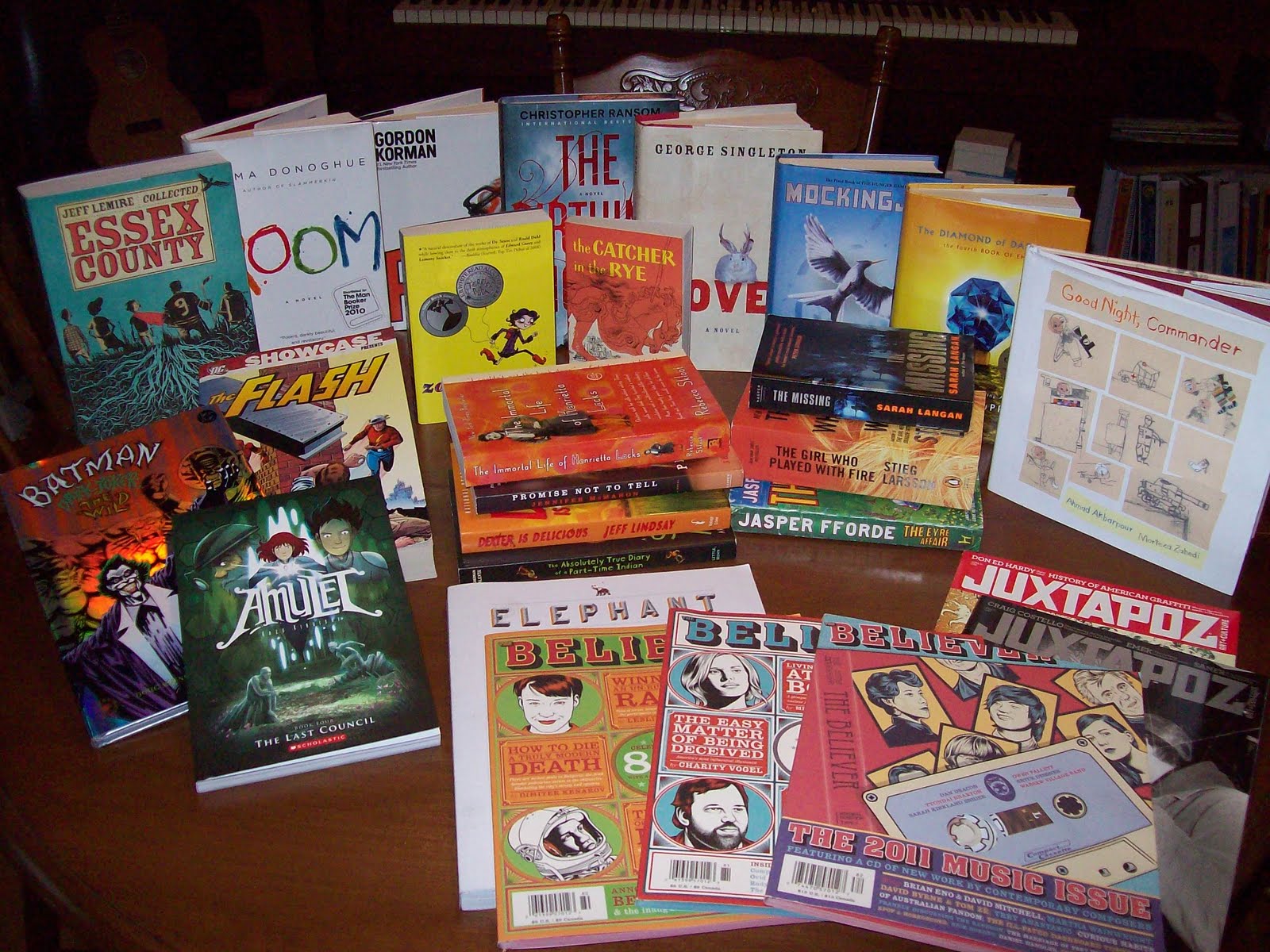
Now comes the challenging task of figuring out where to put this collection on my numerous -- but generally jam-packed -- bookshelves.
The Summer 2011 Reading Spectacular #9
Two more books to add!
Several years ago I picked up and read Something Rotten by Jasper Fforde. I hadn't realized at the time that it fell several books into a series. I still read it, filling in the essential blanks using clues within the text (how's that for teacher talk?) and enjoyed the book immensely. It seemed appropriate, naturally, to go back and start at the beginning, and that's what I did this summer, reading The Eyre Affair, book one in the Thursday Next series.
Oh, how to describe this book? Imagine a world (a 1985, specifically), in which Dodos have returned as housepets thanks to cloning, in which the English and Russians are at war over the Crimea, The Goliath Corporation holds suspicious power over politics, and disturbances in the time-space continuum sometimes occur along the highway. Even better, works of art and literature are like pop-stars, with rabid fans but also inspiring criminal masterminds to attack them. Oh, that's just the tip of the iceberg. So much absurd fun!
I also read Amulet: Book Four - The Last Council by Kazu Kibuishi. I reported briefly on the first book in the series as part of my first ever Summer Reading Spectacular entry. A kid-friendly fantasy series, I'm still enjoying the series, though the sparse dialogue makes for a very quick read, leaving me feeling, at times, that I'd like the story to make more progress in a given volume. The artwork is quite nice, with backgrounds particularly impressive in their detail and beauty contrasted with very simple, flat character designs. Characters can also look a lot alike -- the facial design is very simple and used often -- so pay attention to hair and clothing to help keep everyone straight. I'm not sure how long this series is expected to last, but word has it a movie is in the works.
Sunday, September 04, 2011
The Summer 2011 Reading Spectacular #8
Not far from the finish line for another summer...
First up in this entry, Mockingjay by Suzanne Collins. The final entry in the Hunger Games trilogy, it was a satisfying conclusion to the series, though I can't deny that the love triangle thread (between Katniss, Peeta, and Gale) has become a bit tiresome by the time we reach the halfway point in this, the third book in which it figures. I was unbothered by the unresolved pieces of the puzzle (I'm not a fan of everything being too tidily resolved, at the best of times). All told, it's a young adult series worth reading, and adults will find it an enjoyable light read, too. I'm hoping the film adaptation doesn't mess it up. Previews look good, at least.
Another issue of The Believer (No. 82 -- The Music Issue) was completed early in August. Who knew that they tried putting turntables in car dashboards in the 60s (other than those who were looking to buy luxury cars in the 60s)? Where else would an article about the bassoon (and its reputation as the orchestral comedian) be entitled 'The Farting Bedpost'? Did you know that KPOP (Korean Pop Music) had a rabid fanbase that would make Beatlemaniacs blush? Good times (with bad comics, again).
Showcase presents The Flash, after a shelf-sitting hiatus, came back into the reading circulation and was finished at last. A collection of black-and-white reprints from the 60s (over 500 pages' worth!), it is highly amusing to see how the tone of comics has changed since the Silver Age. Apart from a general sense of camp in the storytelling, it's also entertaining to see how the prevalence of "radiations" of all sorts reflects the times.
Keeping in the comics genre, I re-read the graphic novel Batman: Dark Joker - The Wild, an Elseworlds story from 1993. I'd pretty much forgotten the whole thing until I unearthed it while sorting things from the basement in the Spring. While the concept is intriguing (in a Medievalesque fantasy land, Dark Joker is a powerful and evil wizard; the Batman is the disfigured hero who will bring about his fall), the storytelling itself isn't quite as strong as I would like. The artwork, on the whole, is quite nice, though, with a little gore to spare.
Friday, July 01, 2011
Summer 2011 Reading Spectacular #1
So, apparently this weblog really only comes to life in the summer. I wonder why that would be. Hmmm...
In any case, it's the first of July and time for the Summer Reading Spectacular to begin! And begin it has! Today I threw caution to the proverbial wind, neglected the domestic drudgery which beckoned, and had a rather productive reading day, finishing off a few in-progress reads and reading one other volume start-to-finish.
First off, I wrapped up Novel by George Singleton. In the interests of full-disclosure, I should point out that I started this novel months ago, but it ended up shelved for quite some time before I came back to it. Why? Well, it's a bit of an absurd comic novel that's ... how to put this ... not so funny. It promises to be a hoot, with its fancy dust-jacket-flap-teaser, but it just didn't really pan out for it. George Singleton is widely known for his comic short stories, and maybe it just works better in smaller packages. The book has its moments, but as a whole it just didn't engage the way I'd hoped. I won't even get into the details of why, as it would end up being a hodge-podge of seemingly random points, much like the book itself. I'm not saying it's irredeemably awful, but I'll not be finding a place for it to reside permanently on my valuable shelf-space. (Sorry, George! It wasn't my figurative cup of tea.)
Moving along, I wrapped up Elephant Magazine: Issue 4. You may recall, if you were reading last summer that I discovered and love this magazine about art and "visual culture". This issue spends quite a bit of time discussing graphic design and designers. It also features an article about Supermundane and his work, which led to a series of art lessons in my class, who loved his work. (Check out his website here!) Crazy fun!
I also finished Jeanne DuPrau's The Diamond of Darkhold, the fourth book in the Books of Ember series. I'd started it a few days ago, having been loaned it by a former student of mine, and whipped through it quickly. It's a breezy, quickly paced read intended, of course, for young readers. While it does, in many ways, tread similar ground to the original Ember book, that was somewhat refreshing after the third book in the series, which, in attempting a prequel to the previous, rather fell flat and seemed misplaced within the sequence. There's not much new brought to the series by this book, and in fact the central plot point of the book seems a bit forced, but it's fine for what it is. The final few pages, however, are a bit much. I'll leave it at that in order to avoid typing the phrase "spoiler alert". (Incidentally, the word "Darkhold" only occurs once, perhaps twice, in the book itself, and of very marginal importance even then, leading me to believe that DuPrau snuck it in just to give the book a snappy title.)
Finally, I read Pocket Book One* of Jeff Smith's RASL. Not child-friendly fare as his previous (and multiple award-winning) Bonewas, this is a time-and-space jumping Sci-Fi graphic novel. Though Smith's drawing style isn't quite as well-suited to this type of story -- the distinctly cartoon nature of his human figures worked quite brilliantly opposite the Bone cousins, but doesn't quite match the grittier concept here -- the writing is somehow both briskly paced and patient simultaneously. Towards the end of the volume, a significant number of panels gives over to exposition in the form of background information about Nikola Tesla, but by then, we've been given enough story and action to forgive the lecture. The latter third also gives us the most striking visual of Book One: a mysterious and eerie little drooling girl with a cocked head.
And that's the start to the summer. Not bad for Day One.
*This "Pocket Book" would require a pocket able to accommodate its 8.9 by 6.4 by 0.6 inch size. (Thank you, Wikipedia, for not making me find a ruler or measuring tape.)
Subscribe to:
Posts (Atom)